Urban Vehicle Access Regulations (UVARs) - PIARC Briefing Note
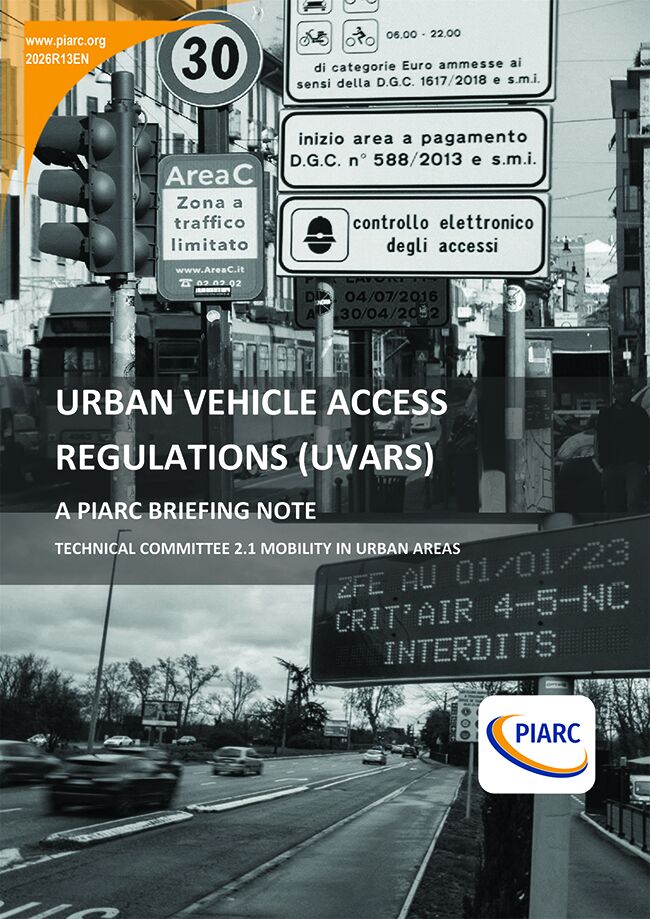
This Briefing Note has been prepared by Working Group 2.1.2 on Urban Vehicle Access Regulations (UVARs) of Technical Committee 2.1 – Mobility in Urban Areas for the 2024–2027 PIARC cycle. Building on the international collection of 29 case studies and the associated literature review, it provides a policy-oriented synthesis of how UVARs are defined, designed, implemented, monitored, and adapted across diverse governance, legal, socio-economic, cultural, and territorial contexts.
UVARs constitute a broad family of measures regulating motorised access to urban areas according to criteria such as vehicle emissions, vehicle type, time of access, user status, pricing, or specific permits. They include emission zones, congestion zones, limited traffic zones, pedestrian areas, parking-based access regulations, freight and delivery restriction zones. Their development is uneven across the world: some schemes are long established and highly institutionalised, while others are recent, lighter, or experimental responses to local challenges related to congestion, air and noise pollution, greenhouse-gas emissions, road safety, accessibility, and the allocation of scarce public space.
A central conclusion of the report is that there is no universal UVAR model. The objectives, design, acceptability, and effectiveness of access regulations depend strongly on local priorities, institutional capacity, mobility alternatives, and social conditions. In low- and middle-income countries (LMICs), for example, UVARs are often shaped less by environmental objectives alone than by immediate concerns relating to road safety, accessibility, congestion management, and basic infrastructure provision. In such settings, measures must be carefully aligned with local needs and constraints; otherwise, they may be perceived as externally imposed, technically unrealistic, or socially inequitable.
The evidence reviewed shows that UVARs can generate significant benefits when they are designed coherently and embedded in wider mobility, climate, health, road-safety, logistics, and public-space strategies. At the same time, these benefits are neither automatic nor evenly distributed between the urban and peri-urban zones. The Briefing Note therefore emphasises that UVARs should be understood as adaptive public policies rather than one-off regulatory interventions. Effective schemes require multi-level governance, coherent legal frameworks, transparent communication, early stakeholder engagement, and explicit attention to equity from the design stage.
Implementation arrangements should be proportionate to the UVAR typology, scale, and institutional capacity of the scheme. Technology can improve enforcement and usability, but it should not be treated as an end in itself: the decisive conditions remain clarity, reliability, proportionality, interoperability, privacy protection, affordability, and long-term operational sustainability.
Monitoring and evaluation are essential to demonstrate impacts, maintain public confidence, and support policy learning. Future evaluation frameworks should therefore move beyond the regulated core and assess effects at the scale of the wider mobility system, including peri-urban spillovers, distributional impacts, access to essential services, freight performance, business effects, and the durability of modal change.
Overall, the Briefing Note shows that UVARs can contribute to cleaner, safer, more accessible, and more liveable urban and peri-urban areas when they are context-sensitive, evidence-based, socially legitimate, and institutionally feasible. Their transferability depends less on copying individual schemes than on adapting their underlying principles to local mobility needs, governance capacity, social conditions, and available alternatives. The next generation of UVAR practice should therefore prioritise equity, territorial coherence, monitoring quality, and practical guidance for small and medium-sized cities and LMICs that remain underrepresented in the current evidence base.
Information sheet
- Date: 2026
- Author(s): Comité technique / Technical Committee / Comité Técnico 2024-2027 2.1 Mobilité dans les zones urbaines / Mobility in Urban Areas / Movilidad en zonas urbanas
- Domain(s): Urban Mobility
- Type: 2026R13EN - PIARC Briefing Note
- PIARC Ref.: 2026R13EN
- ISBN: 978-2-84060-871-4
- Number of pages: 49