Impact of the Development of Active Transport Modes in Road Tunnels - Current Situation Report and Case Studies
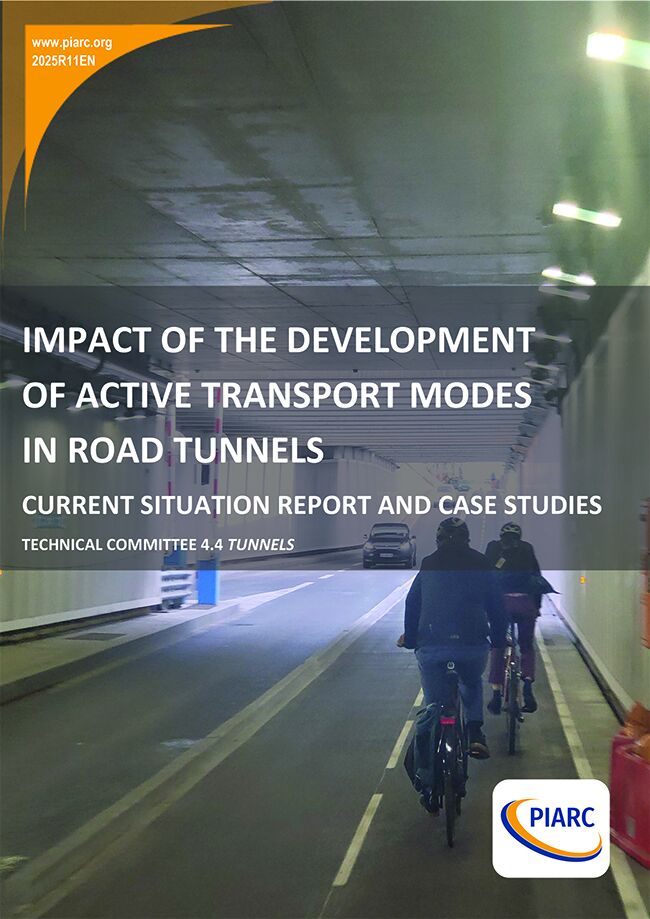
Active modes of transport, which are increasingly demanded by society and infrastructure managers, especially in large cities, in order to improve mobility, reduce emissions and make transport more accessible to all types of users, represent a new challenge for road managers, especially when it comes to tunnels. Active modes of transport are those that affect personal mobility, that is to say, pedestrians, cyclists, skaters, skateboards, scooters, wheelchairs, etc.
In this context, the authorization of active modes in tunnels raises the question of how to ensure that they are safe for all types of users, accessible and integrated into the environment in which they are located. To this end, they can either be built to fulfill this task or adapted for this purpose by carrying out the civil works required, adapting the installations and equipment or complementing them to meet new demands, and reviewing the operating and management procedures so that they are in line with the new reality and can be coordinated with the emergency services.
In view of the economic cost that this may entail and mainly the consequences that the presence of active modes of transport may cause, this information note, which includes a collection of analysed case studies, compiles, evaluates and comments on the international experience related to this issue. The cases presented in the document have been written by experts from all over the world and present examples particularly suitable for understanding the need to implement measures to ensure that vulnerable road users can circulate through tunnels under adequate safety conditions.
To articulate the situation we find ourselves in, the cases are divided into four categories that approach the problem from different perspectives, but with the same ultimate goal: safety.
- Tunnels with a safety gallery that can be used by active modes of transport.
- Tunnels for active modes of transport with protected spaces.
- Tunnels with specific geometry, signaling or operating conditions.
- Tunnels entirely dedicated to active mobility.
This information note thus provides an overview of the state of the art in the international context of the impact of active modes of transport on tunnels, and serves as a basis for the subsequent drafting of a document of recommendations and measures to be adopted, which will be used for decision-making by tunnel owners, managers and operators, as well as for designers, safety experts and risk analysis specialists involved in the planning, design and execution of road tunnels, in which this type of active modes of transport is authorized.
Information sheet
- Date: 2025
- Author(s): Comité technique / Technical Committee / Comité Técnico 2024-2027 4.4 Tunnels / Tunnels / Túneles
- Domain(s): Road Tunnel Operations
- Type: 2025R11EN - Impact of The Development of Active Transport Modes in Road Tunnels - Current Situation Report and Case Studies
- PIARC Ref.: 2025R11EN
- ISBN: 978-2-84060-792-2
- Number of pages: 176