Technical Reports Road safety
This page lists technical reports of PIARC in the field of road safety. These publications are classified chronologically.
-
Improvements in safe working on roads
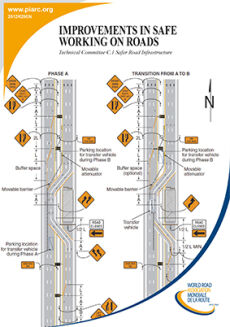
The focus of this guide is on safety of both workers and road users in construction zones. For the safe, efficient and effective management of work zones, it is proposed that a 4 C's principle be adopted. Work zones should be designed, operated and maintained such that the works are conspicuous, clear, consistent and credible. The report addresses in its different chapters: The roles and responsibilities in the work zones; Planning and design of work zones; Safe and efficient operations [...]
-
Best practices for road safety campaigns
The report presents key findings of a literature review of best practices for road safety campaigns, and relate these to actual road safety campaign practices by road administrations and authorities of fourteen countries who responded to a survey questionnaire. The report covers the following key focus areas: Road User Behaviour (including reference to theories of behaviour change), Types of Road Safety Campaigns, Target Audiences, Campaign Media, and Campaign Evaluation. [...]
-
State of the practice for cost-effectiveness analysis, cost-benefit analysis and resource allocation
This report examines the economic analysis techniques applicable to investments to improve road safety, in order to optimize the allocation of available resources. It presents the basics of project evaluation before detailing the methods of cost-effectiveness and cost-benefit analysis. The report also discusses the valuation of the cost of road accident casualties and discusses the valuation according to the income level for different countries. It then presents the data needed to assess the [...]
-
Best practice for road tunnel emergency exercises
Emergency exercises are an integral part of the planning process of road tunnel safety. Drawing on international experience in this area, this report is in the form of a detailed guide for defining objectives, prepare, implement and evaluate an exercise in the most efficient and productive as possible. It also contains practical information on the resources and personnel required for the organization of an emergency exercise, on the costs and outcomes. For non-yet experienced emergency exercise [...]
-
Taking advantage of intelligent transport systems to improve road safety
Intelligent Transport Systems 1 (ITS) have been used for more than 20 years. ITS is rapidly entering the marketplace and is likely to penetrate a greater part of the vehicle fleet in the next 10 - 15 years. Applied effectively, ITS can save lives, time, and money as well as reduce threats to our environment. The general message is that ITS should be applied for easing the task of the driver: ITS will also reduce the driver's risk of being involved in a crash. But one has to be careful because [...]